INTRODUCTION
Lens extraction surgery for cataract to correct a refractive error is the most frequently performed surgical procedure worldwide. Currently, every lens extraction procedure is also a refractive procedure [1].
Growing patient expectations for good vision without spectacles at various distances place additional demands on the surgeon. In addition to performing the procedure correctly, the surgeon must select an intraocular lens (IOL) that meets the patient’s visual needs and calculate its power to minimize the risk of residual postoperative refractive error [2–4].
For today’s patients, excellent distance vision alone is no longer sufficient. Changes in lifestyle in recent years have increased the demand for lenses that provide vision at intermediate and/or near distances. Consequently, multifocal and extended depth-of-focus (EDOF) lenses have been introduced. However, these lenses have certain limitations, particularly with regard to unwanted optical phenomena such as halos and glare [2, 5].
The Tecnis Eyhance DIB00 lens (Johnson & Johnson Vision, Irvine, CA, USA) features an innovative design that provides intermediate vision. It was approved for use in in the United States by the Food and Drug Administration (FDA) in 2019. It has been available in Poland since 2020.
Tecnis Eyhance is an enhanced monofocal IOL with an increased depth of focus. This is achieved through the specially designed anterior surface of the IOL, whose asphericity provides a gradual defocus of up to 1 diopter (D), enabling intermediate vision. According to the manufacturer, the Tecnis Eyhance IOL provides good distance vision as well as intermediate vision at approximately 70 cm [5–9]. As the IOL retains a monofocal design, its implantation is not expected to result in additional optical phenomena such as halos or glare.
The increasing number of younger patients opting for lens exchange surgery places additional demands on ophthalmic teams to perform procedures quickly and efficiently, allowing for the earliest possible visual rehabilitation.
During the coronavirus disease 2019 (COVID-19) pandemic in 2020–2023, healthcare professionals faced the need to increase the number of medical procedures performed while reducing the number of patient visits to minimize exposure to potential infection. In this period, the Warsaw Eye Hospital began performing immediate sequential bilateral cataract surgery, which has since become routine practice at this center.
MATERIAL AND METHODS
The medical records of 214 eyes in 107 patients who underwent surgery at the Warsaw Eye Hospital between 2021 and 2023 were retrospectively analyzed. All patients underwent immediate sequential bilateral removal of the natural lens with implantation of the Tecnis Eyhance DIB00 IOL (Johnson & Johnson).
The study was conducted in accordance with the principles of the Declaration of Helsinki. Approval was obtained from the Bioethics Committee at the Medical University of Warsaw (No. AKBE/148/2023).
Inclusion criteria:
age over 50 years;
patients who underwent uncomplicated phacoemulsification for age-related cataract with implantation of a monofocal-plus Tecnis Eyhance IOL (Johnson & Johnson);
absence of ocular pathology, confirmed by optical coherence tomography (OCT) of the macula and optic nerve head.
Exclusion criteria:
patients with a history of refractive surgery;
coexisting corneal diseases, such as keratoconus, or corneal damage;
corneal endothelial cell count below 1,000 cells/mm2;
instability of the lens zonular apparatus, regardless of cause;
corneal astigmatism greater than 1.0 D, which, according to the authors, constitutes an indication for implantation of a toric lens;
complications of cataract surgery associated with anterior or posterior capsular tears;
simultaneous surgical procedures, including combined cataract removal and vitrectomy;
medically treated unstable glaucoma resulting in optic nerve damage;
coexisting retinal diseases, such as epiretinal membrane, macular hole, macular drusen, and other retinal pathologies;
any previous eye surgery.
In all patients, uncorrected visual acuity (UCVA) and best corrected visual acuity (BCVA) for distance and near were assessed before surgery using standardized ETDRS (Early Treatment Diabetic Retinopathy Study; Precision Vision, Woodstock, USA) charts. Visual acuity measurements were also performed in a standardized optometric examination room. Assessments were performed at 6 and 12 months after surgery.
To assess long-term outcomes, a clinical evaluation was performed after a 12-month follow-up period. Intraocular pressure was measured, and standard examinations of the anterior and posterior segments of the eye were performed after pharmacological pupil dilation. Corneal topography was also performed using the Pentacam system (Oculus, Germany), and intraocular lens power was calculated. The fourth- generation Barrett Universal II formula was used to calculate the implant power.
In each patient, surgery was performed immediately sequentially on the right and left eyes. The procedure was performed by the same experienced surgeon using the EVA system manufactured by DORC (now ZEISS, Germany). The main port incision was 1.8 mm in diameter. After surgery, all patients were fitted with a transparent dressing over both eyes that allowed partial vision.
Postoperative follow-up visits were conducted on days 1, 7, and 28 after surgery. During follow-up visits, the condition of the eye was assessed, and potential postoperative complications, including corneal damage, endophthalmitis, or retinal detachment, were monitored.
Assessment of refraction and visual quality, the results of which were used in the statistical analysis, was performed 12 months after immediate sequential bilateral cataract surgery and IOL implantation. It encompassed standard optometric and ophthalmological examinations, including intraocular pressure measurement and assessment of the anterior and posterior segments of the eye.
As part of the optometric examination, contrast sensitivity was assessed using contrast sensitivity charts, and postoperative refraction and visual acuity with and without correction were measured separately for each eye at 30 cm, 70 cm, and distance, under different lighting conditions. An illuminance of 390.4 lx was established as good lighting conditions and 11.0 lx as low-light conditions. All visual acuity measurements were performed under standardized conditions using ETDRS charts. Visual acuity results were recorded using the logMAR scale. Postoperative refraction and keratometry data were also collected. All optometric procedures were performed in a standardized optometry examination room.
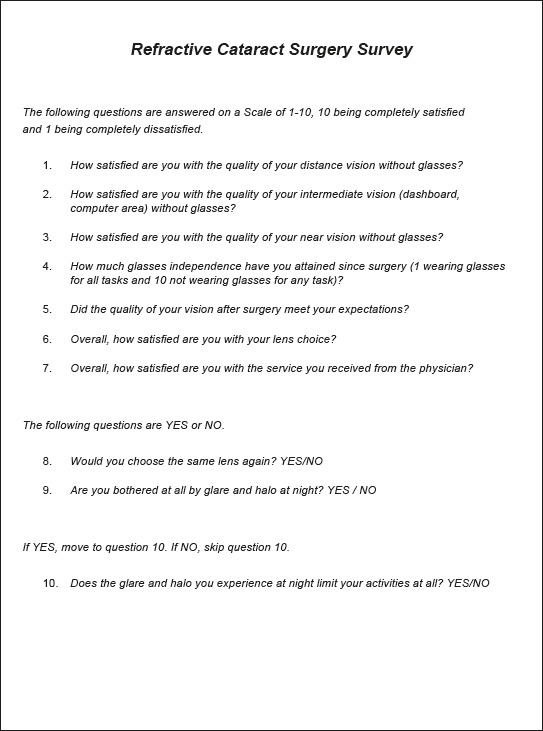
Patient satisfaction was assessed using the Refractive Cataract Surgery Survey (RCSS). The questionnaire assesses patient satisfaction after cataract surgery with binocular vision without spectacle correction on a scale of 1 to 10. The RCSS questionnaire is presented in Figure 1.
Figure 1
Patient satisfaction questionnaire following refractive lens exchange – Refractive Cataract Surgery Survey
Pre- and postoperative refraction was expressed as the spherical equivalent. The spherical equivalent (SE) was calculated using the following formula:
SE = S + 1/2C, where: SE is the spherical equivalent, S is the spherical power, and C is the cylindrical power.
Statistical analysis was performed using IBM SPSS Statistics 25. The chi-square (χ2) test was used to assess whether the compared groups were of equal size. The Wilcoxon signed-rank test was used to evaluate the statistical significance of differences between two measurements within the same group, whereas the Friedman test was applied when comparing more than two measurements within the same group. Nonparametric tests were employed due to deviations of the analyzed variables from a normal distribution. Spearman’s rank correlation analysis was used to assess the relationships between the analyzed variables. The following descriptive statistics were used in the analysis: mean, standard deviation, median, minimum and maximum values, and the first and third quartiles. The level of statistical significance was set at p < 0.05.
RESULTS
The study included 107 patients: 52 women (48.6%) and 55 men (51.4%). The mean age of the patients was 67 years. All patients underwent bilateral, immediately sequential, uncomplicated cataract surgery with implantation of the Tecnis Eyhance DIB00 lens (Johnson & Johnson).
In all patients enrolled in the study, IOL power was calculated to achieve postoperative emmetropia. No form of monovision was used. The fourth-generation Barrett formula was routinely used to calculate IOL power. Axial length of the eyes in the study population ranged from 20.59 mm to 27.15 mm, with a mean axial length of 23.63 mm.
The mean postoperative refraction, expressed as spherical equivalent, was –0.35 D and did not change during the 12-month follow-up period (Table I).
Table I
Postoperative refraction in the study group (N = 214)
| Mean | –0.35047 |
|---|---|
| Min | –1.25 |
| Max | 0.75 |
| Med | –0.25 |
| SD | 0.412792 |
UCVA at a distance of 30 cm was similar under low and good lighting conditions, at 0.76 and 0.78 logMAR, respectively. For BCVA, the results under poorer lighting conditions (i.e., with a larger pupil) were 0.19 logMAR, while under better lighting conditions and with a smaller pupil, they were 0.23 logMAR. This difference was statistically significant (Z = 3.36; p = 0.001). Visual acuity results for a distance of 30 cm are presented in Table II.
Table II
Descriptive statistics for uncorrected visual acuity (UCVA) and best-corrected visual acuity (BCVA) at a distance of 30 cm under illuminances of 11.0 lx and 390.4 lx
At a distance of 70 cm, both UCVA and BCVA were better under poorer lighting conditions. UCVA was 0.03 and –0.03 logMAR under better and poorer lighting conditions, respectively. BCVA at this distance was –0.04 logMAR under poorer lighting conditions and –0.01 logMAR under better lighting conditions. These results were statistically significant (Z = 2.87; p = 0.004). The results are presented in Table III.
Table III
Descriptive statistics for uncorrected visual acuity (UCVA) and best-corrected visual acuity (BCVA) at a distance of 70 cm under illuminances of 11.0 lx and 390.4 lx
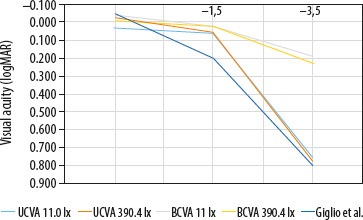
The defocus curve obtained in our group of patients after implantation of the Tecnis Eyhance lens was similar to the defocus curves described for EDOF lenses, including those reported by Giglio et al. [10]. The result is presented in Figure 2.
Figure 2
Defocus curve for uncorrected visual acuity (UCVA) and best-corrected visual acuity (BCVA) for the Tecnis Eyhance lenses and from the study by Giglio et al. [10]
logMAR – logarithmic visual acuity scale; lx – lux, unit of illuminance
For distance vision, both UCVA and BCVA in the study group were the same under different lighting conditions (Table IV). This indicates that good distance visual acuity was maintained after implantation of the Tecnis Eyhance DIB00 lens, regardless of lighting conditions.
Table IV
Descriptive statistics for distance uncorrected visual acuity (UCVA) and best-corrected visual acuity (BCVA) under illuminance levels of 11.0 lx and 390.4 lx
Contrast sensitivity was assessed using the Mars Letter Contrast Sensitivity Test (MARS) charts. Binocular assessment showed a mean score of 1.6 log units in the study population, which is comparable to the results obtained in a healthy population of patients over 60 years of age.
Visual acuity at all distances assessed remained stable during the 12-month follow-up period. No cases of posterior capsule opacification requiring capsulotomy were reported. No significant postoperative complications, such as endophthalmitis, retinal detachment, or implant dislocation, were reported.
Patient satisfaction was assessed using the RCSS questionnaire, in which the maximum score is 10, corresponding to a high degree of patient satisfaction with binocular distance and near vision without spectacle correction. The mean score obtained by patients in the study was 8 points.
Patients did not report any undesirable postoperative optical phenomena, such as halo or glare. Immediate sequential bilateral cataract surgery was not perceived as burdensome by patients. They generally emphasized easier adaptation to the new visual conditions, a shorter postoperative rehabilitation period, and a lower burden on third parties providing care during the postoperative period.
DISCUSSION
Tecnis Eyhance intraocular lenses (Johnson & Johnson) have been commercially available for several years and have been evaluated in numerous clinical studies. The ICB00 model was the first Tecnis Eyhance IOL to receive marketing approval and is implanted using an injector. More recently, the DIB00 model has become available, designed as a preloaded delivery system in which the IOL is factory-loaded into the cartridge.
The preloaded delivery system is of interest for several reasons. Factory-loading the IOL into the cartridge can shorten surgical time and facilitate delivery into the eye. It may also reduce the risk of inadvertently damaging the IOL haptics during implantation. The preloaded system allows implantation through a 2.2 mm incision, practically regardless of IOL power, compared with a 2.4 mm incision when using a standard cartridge. A smaller incision may reduce the risk of surgically induced astigmatism.
In this study, we examined 214 eyes of 107 patients who underwent bilateral crystalline lens removal and implantation of Tecnis Eyhance DIB00 IOLs (Johnson & Johnson). It is one of only a few studies published to date describing the clinical use of the preloaded Tecnis Eyhance IOL delivery system.
In the present study, we focused on assessing visual acuity under different lighting conditions that patients may encounter in everyday life. We evaluated UCVA in patients after implantation of the Tecnis Eyhance DIB00 IOL under various lighting conditions, rather than at various pupil sizes. We approached this issue differently from most authors, who typically use pupil size as their starting point [10].
This approach was based on the observation that, in everyday life, lighting conditions vary, whereas pupil size in individual patients may differ under the same conditions. Therefore, to assess patients’ visual acuity under conditions approximating real-world settings, various lighting levels must be taken into account. Under the same lighting conditions, individual patients may achieve different visual acuity due to individual differences in pupil size. Vision was assessed at distance, intermediate, and near ranges.
The DIB00 lenses allow patients to achieve distance visual acuity comparable to that obtained after the implantation of standard monofocal Tecnis ZCB00 lenses. In our study, lighting conditions had no effect on distance visual acuity [5].
Despite a mean postoperative refractive error of –0.35 D in the study group, high distance UCVA was achieved regardless of lighting conditions. These findings are consistent with the observations of Mrugacz et al. [11], who reported a mean postoperative refractive error of –0.375 D while UCVA remained high.
Intermediate UCVA in our cohort appears comparable to the values reported by other authors. However, there are substantial discrepancies in the literature regarding how intermediate distance is defined. Depending on the publication, intermediate distance is designated as 65 cm in the studies by Gigon et al. [12] and Auffarth et al. [7], 66 cm by Mencucci et al. [5] and 80 cm by Yangzes et al. [13]. It is therefore not surprising that the visual acuity outcomes reported by these authors differ slightly. Nevertheless, one cannot assume that an approximate calculation of intermediate visual acuity derived from the data presented in those studies would correspond to real-world intermediate visual acuity as evaluated in our study.
The testing distances for visual acuity measurements and the pupil diameters evaluated across these publications are summarized in Table V.
Table V
Comparison of visual acuity under different lighting conditions in published studies
| Author | Implant model | Follow-up period [months] | Lighting conditions | Intermediate distance [cm] | Near distance [cm] | Uncorrected near visual acuity [logMAR] | Uncorrected intermediate visual acuity [logMAR] | Uncorrected distance visual acuity [logMAR] |
|---|---|---|---|---|---|---|---|---|
| Nowosielska et al. | DIB00 | 12 | Scotopic | 70 | 30 | 0.76 | 0.03 | 0.06 |
| Photopic | 70 | 30 | 0.78 | –0.03 | 0.06 | |||
| Gigon et al. [12] | ICB00 | 1–12 | Photopic | 65 | 35 | 0.3 | 0.0 | 0.03 |
| Mencucci et al. [5] | ICB00 | 3 | Photopic | 65 | 40 | 0.475 ±0.119 | 0.283 ±0.096 | 0.041 ±0.042 |
| Auffarth et al. [7] | ICB00 | 6 | Photopic | 65 | – | – | –0.02 ±0.01 | 0.16 ±0.02 |
| Choi et al. [14] | ICB00 | 3 | Mesopic | 66 | 40 | – | 0.03 ±0.05 | 0.05 ±0.05 |
| Yangzes et al. [13] | ICB00 | 3 | Photopic | 80 | 40 | 0.43 ±0.13 | 0.10 ±0.13 | 0.11 ±0.13 |
Based on observations of the distances at which everyday activities are performed, the 70 cm distance adopted in our study as the intermediate distance appears to be appropriate. This value is also close to the intermediate distance used in other studies.
A similar issue arises with the assessment of near visual acuity. Here too, authors use different distances. For instance, Gigon et al. [12] defined near distance as 35 cm, whereas Mencucci et al. [5] and Choi et al. [14] assessed it at 40 cm. Some authors, such as Auffarth et al. [7], operating on the assumption that the Tecnis Eyhance lens does not provide near vision, did not evaluate near visual acuity at all.
In several published studies, superior visual acuity was achieved by employing some form of monovision. Importantly, no form of monovision was utilized in our study. The IOL power in each eye was calculated preoperatively targeting postoperative emmetropia. Therefore, we assessed near visual acuity in emmetropic patients.
Furthermore, our study demonstrated postoperative refractive stability over a 12-month follow-up period. This is one of the longer follow-up periods described in the literature and undoubtedly represents a strength of this study. In comparison, other researchers have reported follow-up periods of 3 months (Mencucci et al. [5], Choi et al. [14]), 6 months (Auffarth et al. [7], Gigon et al. [12]) and 12 months [10].
The results obtained in our study showed that intermediate visual acuity after implantation of the Tecnis Eyhance DIB00 IOL was better under poorer lighting conditions, whereas near visual acuity at 30 cm did not deteriorate with decreasing illumination. We did not find any previously published studies evaluating the effect of lighting conditions on intermediate visual acuity following implantation of the Tecnis Eyhance IOL.
The observed phenomenon may be related to the optical design of the implant. Under conditions of reduced illumination, pupil dilation occurs, which may result in the use of more peripheral areas of the IOL’s optical surface. This phenomenon may have practical significance, as it may contribute to maintaining good intermediate vision under conditions of reduced lighting.
However, the observed relationship between lighting conditions and intermediate visual acuity requires further research, particularly with simultaneous assessment of pupil diameter and the IOL’s optical parameters.
In summary, our study demonstrated that Tecnis Eyhance DIB00 IOLs provide patients with a high degree of spectacle independence in everyday life. They provide high UCVA at distance and at intermediate range. Importantly, they also allow UCVA at 30 cm to reach 0.76–0.78 logMAR.
Patients in our study did not report optical phenomena such as halo or glare, which is consistent with expectations based on the lens design. No reduction in contrast sensitivity was observed after surgery.
Bilateral lens removal as part of a single-session procedure is associated with savings in time and costs, as well as less inconvenience for patients and their families. Following bilateral surgery, visual rehabilitation may proceed more rapidly, and the possibility of simultaneously prescribing near spectacle correction for both eyes allows patients to return more quickly to work and leisure activities.
In the study group, immediate sequential bilateral removal of the crystalline lens was not associated with any serious postoperative complications. No cases of endophthalmitis or other serious adverse events were reported.
The limitations of the study were its retrospective design and lack of randomization.
The strengths of the study included the relatively large sample size, the 12-month follow-up period, the assessment of near and intermediate visual acuity under different lighting conditions, and the use of the preloaded Tecnis Eyhance DIB00 lens.
CONCLUSIONS
The Tecnis Eyhance DIB00 lens (Johnson & Johnson Vision, Irvine, CA, USA) provides patients with functional near vision at a distance of 30 cm without spectacle correction. At this distance, uncorrected visual acuity ranged from 0.76 to 0.78 logMAR. This parameter is usually overlooked in research studies, which – consistent with the manufacturer’s claims – assume that the Tecnis Eyhance lens does not improve near vision, but only intermediate and distance vision.
Visual acuity at 70 cm with the Tecnis Eyhance lens was only slightly altered under low-light conditions compared with good-lighting conditions. This is a beneficial parameter for patients, ensuring good vision under poorer lighting conditions, when the pupil is dilated.
Distance visual acuity after implantation of the Tecnis Eyhance DIB00 lens remained unchanged regardless of lighting conditions.
Patients did not experience a reduction in contrast sensitivity or optical phenomena such as halo and glare, and they reported a high degree of spectacle independence and satisfaction.
Patients rated the immediate sequential bilateral removal of the crystalline lens positively, indicating a shorter period of visual rehabilitation following the procedure.